
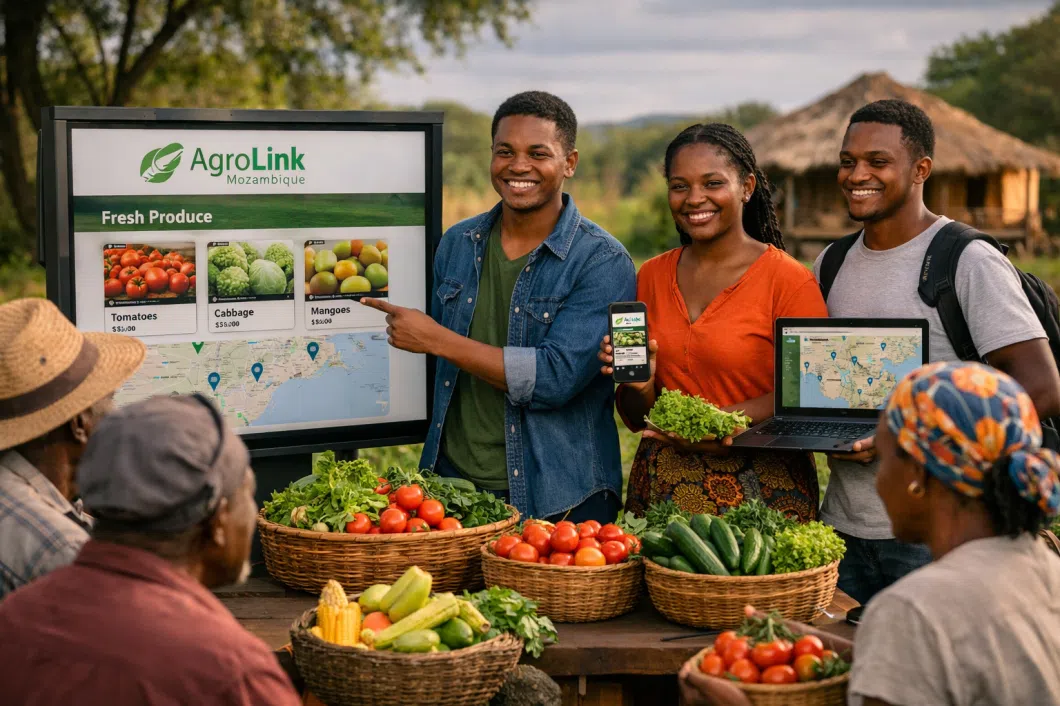
In the bustling streets of Maputo, where tradition meets modern ambition, a group of young Mozambicans decided to tackle one of the country’s most persistent challenges, the disconnect between rural producers and urban consumers. They had seen farmers struggling to sell their crops at fair prices while city dwellers paid high costs for fresh produce. The gap was not in supply or demand; it was in connection.
That realization sparked the birth of AgroLink Mozambique, a mobile application designed to bridge this divide. The founders, three university graduates passionate about technology and social impact, began with a simple idea: create a digital marketplace where farmers could sell directly to consumers, restaurants, and small retailers.
At first, the project seemed ambitious. Internet access was limited in rural areas, and many farmers had never used smartphones. But the team refused to give up. They traveled across provinces, conducting workshops on digital literacy and mobile payments. They partnered with local cooperatives and NGOs to provide training and affordable devices. Slowly, the network began to grow.
Within six months, AgroLink had onboarded over 200 farmers from Sofala, Manica, and Gaza provinces. The platform allowed them to upload product photos, set prices, and receive payments through mobile money. For the first time, farmers could negotiate directly with buyers, eliminating middlemen who often took the largest share of profits.
One of the early adopters was João, a tomato farmer from Chimoio. Before joining AgroLink, he sold his produce to intermediaries who paid him barely enough to cover costs. After learning to use the app, João began selling directly to restaurants in Maputo. His income tripled within three months. He used the extra money to repair his irrigation system and send his daughter to school.
Stories like João’s spread quickly. Farmers who once felt isolated now shared experiences, exchanged tips, and collaborated on logistics. The app became more than a marketplace, it became a community.
The founders introduced new features: weather forecasts, crop management advice, and a rating system that built trust between buyers and sellers. They also added a delivery coordination tool, connecting farmers with local transporters. The innovation didn’t just improve business; it transformed relationships.
Urban consumers loved the transparency. They could see where their food came from, who grew it, and how it was produced. Restaurants began promoting “farm-to-table” menus featuring AgroLink suppliers. The movement gained momentum, and soon, the app was recognized by local authorities as a model for inclusive digital entrepreneurship.
The impact extended beyond economics. By empowering farmers with technology, AgroLink fostered digital inclusion and financial independence. It encouraged young people in rural areas to see agriculture not as a last resort but as a viable, modern career. It also inspired other innovators to create solutions for healthcare, education, and renewable energy using similar community-driven models.
The team behind AgroLink often says their success lies not in coding but in listening. They built the platform around real needs, adapting it to local languages and cultural contexts. They understood that technology must serve people, not the other way around.
Today, AgroLink connects over 1,500 producers with more than 300 buyers across Mozambique. The founders are working to expand into neighboring countries, aiming to create a regional network of sustainable trade. Their vision is clear: a continent where technology empowers communities, not divides them.
This story triggers powerful emotions, hope, because it shows that innovation can emerge from empathy; trust, because it demonstrates transparency in business; and pride, because it celebrates Mozambican ingenuity. It reminds us that progress is not measured only in profits but in lives improved and futures unlocked.
AgroLink Mozambique stands as a testament to what happens when young minds combine purpose with technology. It is proof that social entrepreneurship can connect more than markets, it can connect hearts, communities, and dreams.